For the last stretch of months, almost everything I've built has been pointed at a single moment: getting Tesseract onto the App Store. As of June 2026, it's there — live, worldwide, in people's hands. This is the story of what we made, why we made it the way we did, and what we got wrong along the way.
 ## The problem nobody actually solved
If you've ever been a student stuck on a problem at 11pm, you know the feeling. You have two options, and both are bad.
Option one: a homework app. Photomath, Gauth, ChatGPT. You snap the problem and get back a wall of text steps. Step 1, step 2, step 3. Technically correct. But reading steps you don't understand doesn't teach you anything — it just gets you past tonight's assignment. The concept never clicks. You'll be just as stuck on the next one.
Option two: a video. YouTube, Khan Academy, Coursera. These are real explanations — someone actually walks you through the idea. But they're static and generic. The video was made for everyone, not for the exact question in front of you. So you scrub through twenty minutes hoping your specific problem shows up, and usually it doesn't.
The thing that actually works — the thing that makes a concept click — is a good tutor sitting next to you, drawing it out, narrating each step, answering your question. But that doesn't scale and it isn't cheap. That's the gap we wanted to close.
What Tesseract does
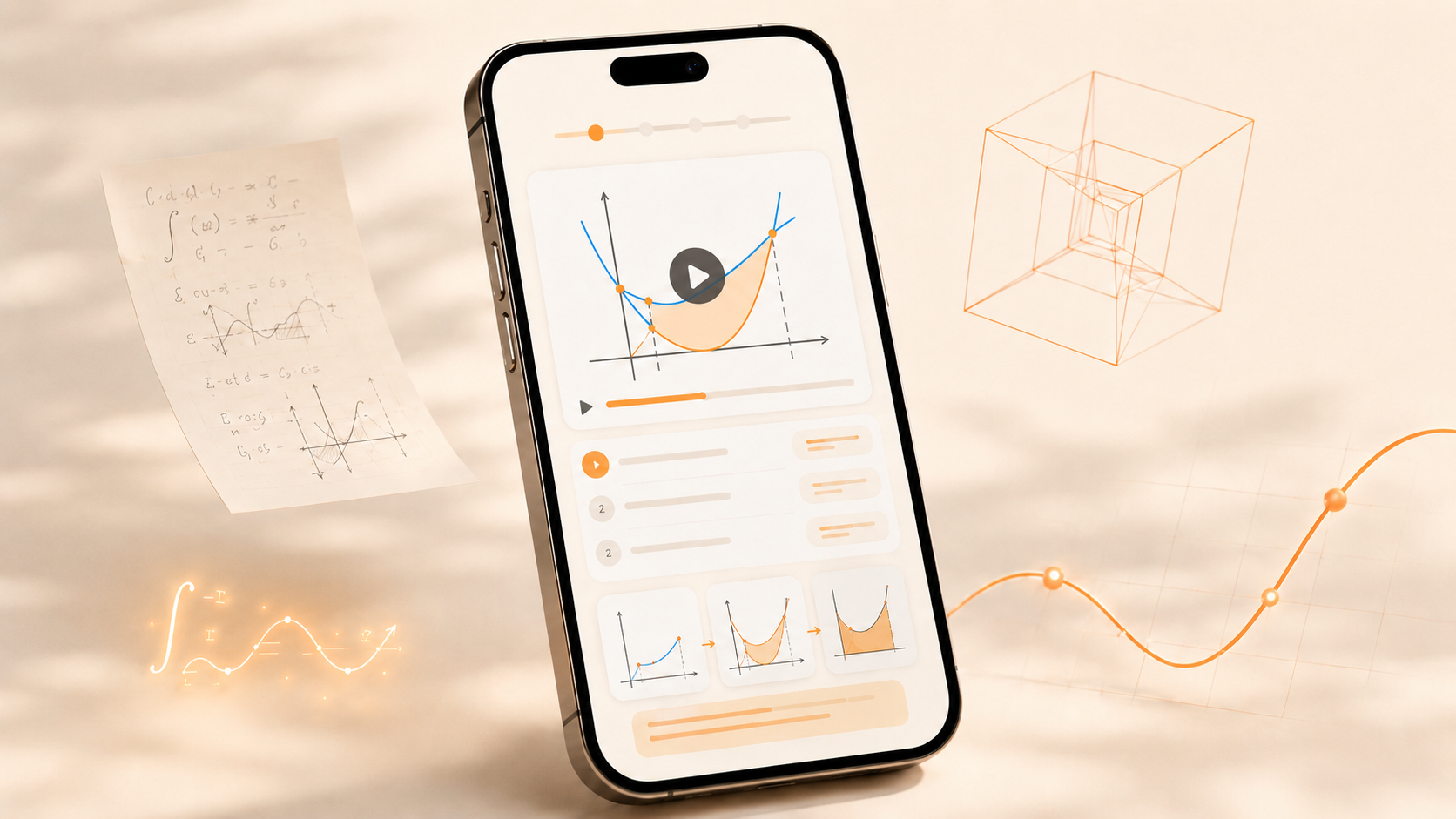
Tesseract takes any question a student has and turns it into a personalized, animated video explanation — narrated and drawn out step by step, the way the best one-on-one tutor would explain it.
Not a list of text steps to memorize. Not a pre-recorded lecture made for someone else. A custom lesson, generated for your exact question, in seconds.
You snap a photo (or type it in), and a few seconds later you're watching an explanation that builds the concept visually while a voice walks you through the reasoning — not just what the answer is, but why.
The part that was genuinely hard
Here's the technical heart of it, and the part I'm proudest of: the videos aren't stock clips or templated slides. Every explanation is generated from scratch using a Manim-powered pipeline.
If you haven't seen it, Manim is the animation engine behind those beautiful math videos — the kind where equations transform and graphs draw themselves smoothly on screen. It's gorgeous, and it's also notoriously finicky to drive programmatically. Getting an AI to reliably produce the teaching logic, then translating that into animation instructions, then rendering, narrating, and stitching it all into a coherent video — fast enough that a student isn't sitting there waiting — was the hardest engineering problem I've worked on.
A few of the things that ate weeks:
- Getting the model to break a problem into the right steps — not just a correct answer, but a sequence that actually builds intuition. Correct and clearly explained are two different things, and for an education product only the second one matters.
- Keeping the structured output reliable enough to feed straight into the animation pipeline, every time, without the whole thing falling over on an edge case.
- Making narration sound like a tutor talking through a problem, not a machine reading text aloud — and keeping that quality consistent across languages, because we launched globally.
None of this is a thin wrapper over an API. The generation pipeline is the product, and building it as a small, mostly self-taught team while studying Computer Science at KIT is the thing I'll remember about this year.
Launching — and being honest about it
Tesseract is live on the App Store right now, worldwide. That sentence took an absurd amount of work to be able to write, so I'm going to enjoy it for a second.
But I also want to be honest, because build-in-public only means something if you include the unfinished parts:
It's free, and it's pre-revenue. We deliberately chose to prioritize the core experience and user growth before turning on monetization. A subscription model is on the near-term roadmap, not in the app today. That's a conscious bet, not an oversight.
EU distribution is currently limited. Because of the DSA trader-status requirements, our European availability is restricted while we work through the compliance side. It's frustrating — Europe is home for me — and it's the next big thing I'm unblocking.
This is a first launch, not a victory lap. I know exactly how much is still ahead. The product works and people are using it, but "live on the App Store" is the starting line, not the finish.
What's next
Three things, in order: restore full EU distribution, turn on a subscription model that's fair to students, and keep widening the range of subjects and question types the pipeline handles well. Underneath all of it, the same north star — does the student actually understand the thing afterward, or did we just hand them an answer?
That's the only metric that has ever mattered here. Everyone else is racing to give students the right answer faster. Students don't lack answers. They lack understanding. We built Tesseract on the bet that the format of the explanation — personalized, visual, narrated, on demand — is what closes that gap.
If you're a student, a parent, a teacher, or just someone who likes seeing a hard thing explained well, Tesseract is on the App Store now. I'd genuinely love your feedback — the rough edges are easier to find when more people are pushing on them.
Thanks for reading. On to the next part.